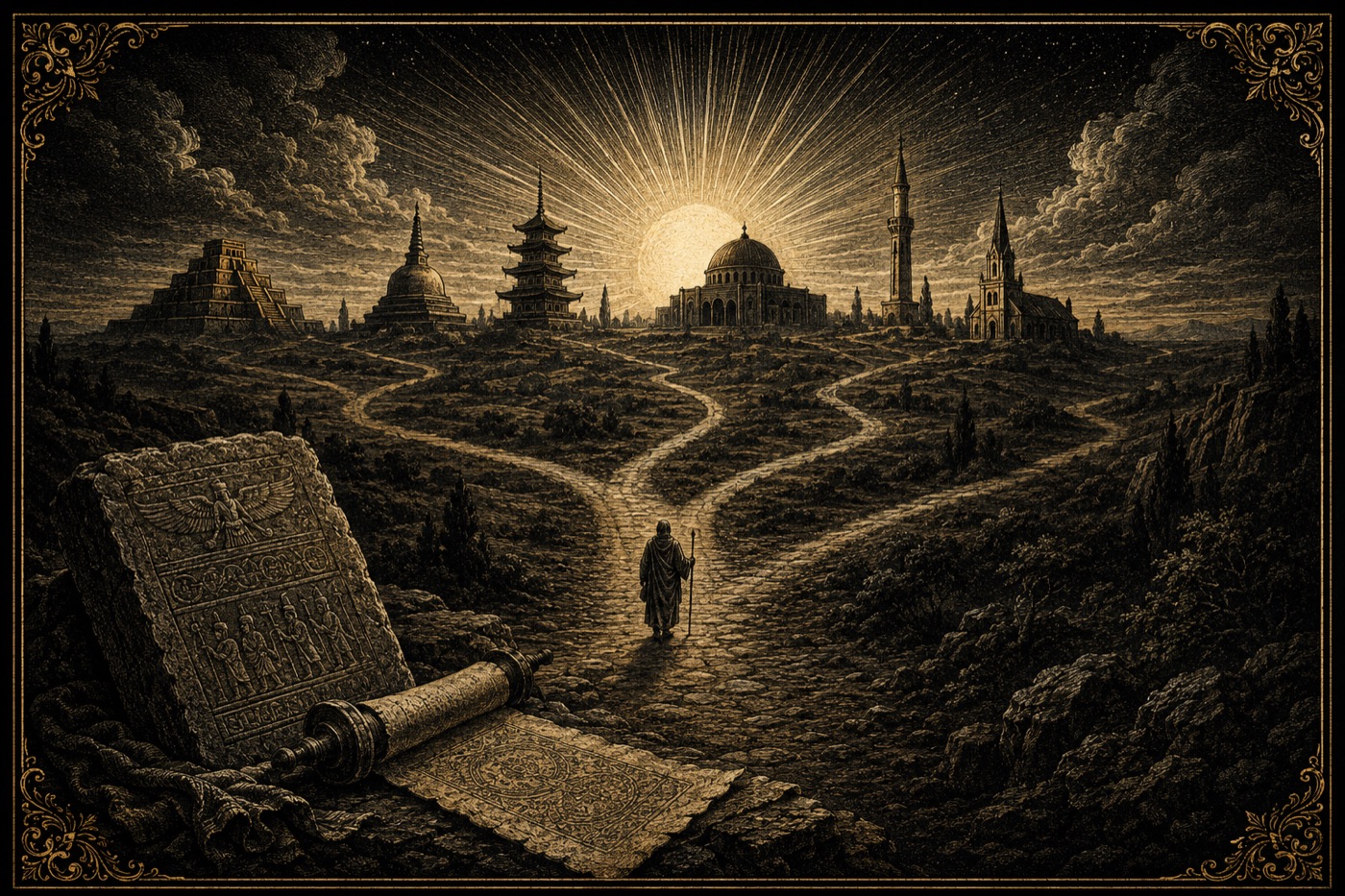
c. 15,000 BCE — the present28 traditions · 68 works · ~45,700 verses

The Pilgrimage

Five thousand years of scripture walked as one road, with turnings — every path chosen, every word quoted, no quarrel settled.

PLATE P-00 · original frontispiece for this edition, composed after the style of Gustave Doré from public-domain sources only — the one road forking through a landscape of scripture; SVG stand-in, data-replace="onesource" for final engraving-quality art.

the cross-religion study Bible, recut as a walk through time · religion.lucid.rodeo · 28 traditions · 68 works · ~45,700 verses

The PilgrimageFront Matter — Coverspread 00
Before you set outthe rules of the walk

How to Read This Book

You are a soul walking through the whole recorded history of the sacred; this page is the map-case you check before the first step.

The Rules of the Walk

Start at §1. The sections are numbered §1 to the end in one unbroken sequence through the whole book; the first written word is where every road begins.

At each fork, choose one road. Junctions end in a rubricated box; each choice names the road and the section it leads to — turn to §N in print, a working link on screen. Take one. The others keep.

Time only runs one way. Every turning moves forward, or sideways, in history — never backward. What you pass unvisited stays behind you; to walk another road, begin the pilgrimage again.

Scripture is quoted verbatim, always from public-domain translations, with translator and year cited at every quotation. Nothing is paraphrased into agreement.

When traditions disagree, both citations stand. Two answers to the same question are set side by side on the page, and the book does not adjudicate. No quarrel is settled here; every quarrel is shown.

Endings close the final era. All of them finish where this corpus lives: the reading room at religion.lucid.rodeo.

The Walk in Ten Eras

I · The Time Before Writing — before c. 3000 BCE

II · The Scribes of the River Valleys — c. 2600–1200 BCE

III · Covenant and Flame — c. 1300–600 BCE

IV · The Prophets and the Questioners — c. 750–400 BCE

V · The Axial East — c. 700–300 BCE

VI · The Turning of the Age — c. 300 BCE–200 CE

VII · The House of Study and the Recitation — c. 200–900 CE

VIII · The Medieval Roads — c. 900–1500

IX · New Dispensations — c. 1500–1900

X · The Reading Room — 1900 to the present

Ten eras, one road. Each era opens with its own band, accent colour and lede; the folio at the foot of every page tells you where you stand.

The Plate Ledger

Every plate in this first edition is an original SVG stand-in that holds space for a real public-domain artwork, named below. A later pass replaces each with licensed photography of the original work.

P-01 · Unknown (Magdalenian painters), Hall of the Bulls, Lascaux cave, c. 15,000 BCE — the aurochs procession by torchlight; image-making before writing, the first sanctuary.

P-02 · Unknown Maya scribes, Dresden Codex (Venus tables), c. 11th–12th century CE — gods and calendrical glyphs; an American cosmology written down after millennia of oral keeping.

P-03 · Unknown Theban scribes and painters, Papyrus of Ani: the Weighing of the Heart, c. 1250 BCE — Anubis at the balance, Thoth recording, Ammit waiting; judgment as bookkeeping.

P-04 · Unknown Assyrian scribes (Library of Ashurbanipal), The Flood Tablet (Gilgamesh Tablet XI), Nineveh, c. 7th century BCE — the cuneiform tablet that gave the modern world back its oldest flood.

P-05 · Gustave Doré, Moses Breaking the Tables of the Law, 1866 — the lawgiver descending Sinai into the noise of the golden calf.

P-06 · Unknown Achaemenid sculptors, Faravahar relief, Persepolis, c. 500 BCE — the winged figure above the audience hall; good thoughts, good words, good deeds in stone.

P-07 · William Blake, When the Morning Stars Sang Together (Illustrations of the Book of Job), 1826 — the whirlwind answer: creation itself unrolled as God's reply to Job.

P-08 · Zhang Lu, Laozi Riding an Ox, early 16th century — the archivist leaving for the western pass with the Tao unwritten behind him.

P-09 · Unknown Gandharan sculptors, The Fasting Siddhartha (Lahore Museum), c. 2nd century CE — the prince starved to sinew and vein; the extreme the middle way rejected.

P-10 · Mughal court painters (Razmnama workshop of Akbar), Krishna and Arjuna at Kurukshetra (Razmnama manuscript), 1598 — the chariot halted between the armies at the moment the Song begins.

P-11 · Gustave Doré, The Sermon on the Mount, 1866 — the crowd on the hillside, the teacher small against the sky.

P-12 · Unknown Kairouan calligraphers, Folio from the Blue Qur'an, c. 9th–10th century — gold Kufic script on indigo vellum; the Recitation as pure visual music.

P-13 · Daniel Bomberg (printer), Venice, Opening page of Tractate Berakhot, first printed Babylonian Talmud, 1523 — Mishnah islanded in Gemara, ringed by Rashi and Tosafot; the argument given its permanent architecture.

P-14 · Sultan Muhammad, The Mi'raj of the Prophet (Khamsa of Nizami, Tabriz), c. 1539–1543 — the night ascent through gold cloud and angel-thronged sky; Persian miniature at its most ecstatic.

P-15 · Sesshū Tōyō, Haboku sansui (Splashed-Ink Landscape), 1495 — a mountain implied by six wet strokes; the koan's answer in ink.

P-16 · Albrecht Dürer, The Four Horsemen of the Apocalypse, 1498 — scripture unleashed by the printing press; the woodcut that rode ahead of the Reformation.

P-17 · Unknown Punjab painters (Janamsakhi tradition), Guru Nanak with Bhai Bala and Mardana, c. 19th century — the Guru between his Hindu and Muslim companions, the rabab sounding between them.

P-18 · Unknown engraver, The Illustrated London News, The New Reading Room of the British Museum, 1857 — the great domed room at its opening; every scripture of the pilgrimage within call of one desk.

P-19 · William Blake, Jacob's Ladder (Jacob's Dream), c. 1805 — souls ascending and descending the spiral stair between earth and heaven; the pilgrimage seen whole.

On diagrams: every diagram in this edition is set in SVG for now, and each is marked data-illustrator="hand-draw" — in the final edition all of them will be redrawn by hand by a single illustrator, one line throughout the book.

The PilgrimageFront Matter — How to Readspread 00
Ibefore c. 3000 BCEDreaming · Maya · Egyptian · Mesopotamian · Vedic · Chinese

The Time Before Writing

Before ink, the sacred lived in breath: songlines, fire-tales, cosmogonies carried whole in human memory. The pilgrim begins in that dark, where every road is still open.

§1 The Fire at the Mouth of the Cave

There is no book anywhere in the world. It is night, and you sit at the mouth of a cave with smoke in your hair and grease on your fingers, and above you, where the torchlight climbs the rock, painted bulls run through the dark. An old man is singing. He is not entertaining you: he is reciting the law — who may marry whom, where the water lies, how the borah ground is cleared, what Byamee did and forbade. If he forgets a verse, the verse is gone from the earth. Everyone here knows this. That is why the song is exact, and why the children mouth it silently, and why, when he ends, no one speaks for a long while.

And Byamee, the mighty Wirreenun, lives for ever. But no man must look upon his face, lest surely will he die. So alone in a thick scrub, on one of the Noondoo ridges, lives this old man, Byamee, the mightiest of Wirreenun.
Australian Legendary Tales, "The Borah of Byamee" — K. Langloh Parker, 1896 (public domain)
PLATE P-01 · after Unknown (Magdalenian painters), "Hall of the Bulls, Lascaux cave" (c. 15,000 BCE), public domain — the aurochs procession by torchlight: image-making before writing, the first sanctuary. SVG stand-in; to be replaced with licensed photography of the original work.

§2 Songs of the Black Land and the Two Rivers

You walk west for a season and come down into a valley that smells of mud and barley beer. The river has just fallen; the fields are black and shining. At dusk a shaven-headed priest stands facing the water and recites the making of the world — how the sun-god spoke himself into being out of the flood — and he recites it exactly as his teacher did, breath for breath, because there is nowhere else the words can live. Weeks east, between two other rivers, other priests are doing the same work in another tongue, mouth to ear, ear to mouth. Nothing is written. Everything is remembered.

The sky (or heaven) had not come into being, the earth did not exist, and the children of the earth, and the creeping things, had not been made at that time. I myself raised them up from out of Nu, from a state of helpless inertness. I found no place whereon I could stand.
The Book of Knowing the Evolutions of Ra (BM Papyrus 10188) — E. A. Wallis Budge, Legends of the Gods, 1912 (public domain)

§4 The Makers in the Dark Sea

You cross a dark water in a hollowed log, and on the far shore, under a sun that has not yet risen for these people's reckoning, an old teller gives you the beginning: the sea silent, the sky empty, the Framer and the Shaper pondering in the gloom. She tells how the gods made people of wood who could not remember their makers, and how the waters rose and took them. You have heard of drowned worlds before, beside other fires. You fold this one into your memory with the rest and carry it back across the water like a live coal.

Over a universe wrapped in the gloom of a dense and primeval night passed the god Hurakan, the mighty wind. He called out "earth," and the solid land appeared. … Then by the will of Hurakan, the Heart of Heaven, the waters were swollen, and a great flood came upon the mannikins of wood.
Popol Vuh, First Book — Lewis Spence, The Popol Vuh, 1908 (public domain)

§3 The Dawn-Singers of the East

Eastward, on the plain of the Seven Rivers, you wake before light to the sound of boys chanting. They sing a hymn forward, then backward, then in braided pairs of syllables, so that no word can ever slip its place; families will carry these verses mouth to mouth for a thousand years before any of it is written, and lose nothing. And the hymn they guard so perfectly is a hymn of doubt. Far to the north-east, you are told, there are diviners who press fire to the shoulder-blades of oxen and read the will of Heaven in the cracks. Everywhere, the same question; not everywhere the same answer. Set the singers' doubt beside the Black Land's certainty, and let both stand:

Who verily knows and who can here declare it, whence it was born and whence comes this creation? The Gods are later than this world's production. Who knows then whence it first came into being? He, the first origin of this creation, whether he formed it all or did not form it, whose eye controls this world in highest heaven, he verily knows it, or perhaps he knows not.
Rig Veda X.129.6–7 (Nasadiya Sukta) — Ralph T. H. Griffith, 1896 (public domain)
I am he who came into being in the form of the god Khepera, and I am the creator of that which came into being, that is to say, I am the creator of everything which came into being.
The Book of Knowing the Evolutions of Ra — E. A. Wallis Budge, Legends of the Gods, 1912 (public domain)
PLATE P-02 · after Unknown Maya scribes, "Dresden Codex (Venus tables)" (c. 11th–12th century CE), public domain — gods and calendrical glyphs: an American cosmology written down after millennia of oral keeping. SVG stand-in; to be replaced with licensed photography of the original work.
WHERE THE FIRST COSMOGONIES WERE SPOKEN River valleys and songlines of the oral age — with the much later dates at which each voice was finally written down MESOAMERICA Popol Vuh spoken for millennia; written c. 1550s CE NILE spoken cosmogonies; first written c. 2400 BCE TIGRIS–EUPHRATES first literary tablets c. 2600 BCE INDUS Vedic hymns recited c. 1500 BCE; written far later YELLOW RIVER oracle bones cracked c. 1200 BCE THE DREAMING songline tracks, sung law of deep time; transcribed 1896 CE river valley where a cosmogony was spoken songline — law carried as sung track oral cosmology written down only much later
DIAGRAM D-01 · River valleys and songlines: where the first cosmogonies were spoken — Nile, Tigris–Euphrates, Indus, Yellow River, Mesoamerica, and the Dreaming tracks of Australia. SVG for now; final art hand-drawn by the book's illustrator.
The PilgrimageEra I — The Time Before Writingspread 01
IIc. 2600–1200 BCEEgyptian · Mesopotamian · Vedic · Early Chinese

The Scribes of the River Valleys

Writing is invented for grain and kings, and the gods seize it at once. The dead receive maps of the underworld, floods are fixed in clay, and the hymns of dawn begin their long approach to the page.

§5 The Weighing of the Heart

The workshop in Thebes smells of soot-ink and acacia gum. On the long table a papyrus unrolls — a scroll bought in advance of dying — and a scribe touches red to the pan of a painted balance. You lean close. A heart sits in one pan; in the other stands a single feather. Anubis steadies the plummet, ibis-headed Thoth waits with his palette, and behind him crouches a devourer with a crocodile's jaws. The scribe recites the words his customer will one day need — forty-two denials before forty-two judges — then paints the small spell that begs the heart itself not to testify against its owner. Judgment here is bookkeeping, and the ledger must balance.

I have not done iniquity. … I have not robbed with violence. … I have not committed theft. … I have not slain man or woman.
Book of the Dead 125, the Negative Confession — E. A. Wallis Budge, 1895 (public domain)
My heart, my mother; my heart, my mother! My heart whereby I came into being! May nought stand up to oppose me at my judgment, may there be no opposition to me in the presence of the Chiefs; may there be no parting of thee from me in the presence of him that keepeth the Balance!
Book of the Dead 30B, the heart-scarab spell — E. A. Wallis Budge, 1895 (public domain)
PLATE P-03 · after Unknown Theban scribes and painters, "Papyrus of Ani: the Weighing of the Heart" (c. 1250 BCE), public domain — SVG stand-in; to be replaced with licensed photography of the original work.

§6 Gilgamesh at the Edge of the World

Weeks east, past the bitter lakes, the caravan brings you under the rampart of Uruk — a wall so wide men race chariots on it. At night a singer lifts the old tablets and you walk inside the tale: the king whose friend Enkidu died, who ran from death across the mountains of the scorpion-men, to a tavern at the rim of the sea. The ale-wife Siduri looks at his ruined face and gives him the oldest advice in the world.

Gilgamish, why runnest thou, (inasmuch as) the life which thou seekest, thou canst not find? The gods, in their (first) creation of mortals, death allotted to man, (but) life they retain'd in their keeping. Gilgamish, full be thy belly, each day and night be thou merry, (and) daily keep holiday revel, each day and night do thou dance and rejoice … cherish the little one holding thy hand; be thy spouse in thy bosom happy — (for) this is the dower [of man].
Epic of Gilgamish, Tablet X (Old Babylonian) — R. Campbell Thompson, 1928 (public domain)

The king rows on anyway, to Utnapishtim the far-away — the one man the gods spared when they drowned the rest. The survivor tells him how a god whispered through a wall of reeds:

O Reed-hut, O Reed-hut! Wall, wall! Hearken, O Reed-hut, consider, O Wall! O thou Mortal, thou of Shurippak, thou scion of Ubara-Tutu, a dwelling pull down, (and) fashion a vessel (therewith); abandon possessions, life do thou seek, (and) thy hoard disregard, and save life; every creature make to embark in the vessel.
Epic of Gilgamish, Tablet XI (the Deluge) — R. Campbell Thompson, 1928 (public domain)
PLATE P-04 · after Unknown Assyrian scribes (Library of Ashurbanipal), "The Flood Tablet (Gilgamesh Tablet XI), Nineveh" (c. 7th century BCE), public domain — SVG stand-in; to be replaced with licensed photography of the original work.

§7 The War of Marduk and the Deep

Downriver, Babylon is keeping the new year. Barley beer, incense, a street packed to the walls — and on the fourth evening, in the shrine of Marduk, a priest chants the whole making of the world as if reading minutes of a war. You stand in the crowd and hear the beginning of everything:

When in the height heaven was not named, and the earth beneath did not yet bear a name, and the primeval Apsû, who begat them, and chaos, Tiamat, the mother of them both — their waters were mingled together, and no field was formed, no marsh was to be seen; when of the gods none had been called into being … then were created the gods in the midst of heaven.
Enuma Elish, Tablet I, 1–9 — L. W. King, 1902 (public domain)

The chant rises to the battle: the young god against the dragon of the salt sea, the mother of all.

And the lord stood upon Tiamat's hinder parts, and with his merciless club he smashed her skull. He cut through the channels of her blood, and he made the North wind bear it away into secret places.
Enuma Elish, Tablet IV, 129–132 — L. W. King, 1902 (public domain)

From her split body, sky and earth; from a rebel god's blood, mankind — kneaded into being to carry the gods' burden of work. You look at your own hands.

§8 The Hymns of the Seven Rivers

Months of passes and fords bring you to a plain of rivers under high snow. Before dawn a priest wakes a fire with butter, and as the flames take, a singer begins — not from a page, for there is no page. These hymns live in trained memory, syllable-perfect, father to son. The fire itself is a god, and the first word of the first hymn is his name:

I laud Agni, the chosen Priest, God, minister of sacrifice, the hotar, lavishest of wealth.
Rig Veda I.1.1 — Ralph T. H. Griffith, 1896 (public domain)

Around the fire you ask the question you carried out of Babylon: where did the world come from? Two hymns answer, and the singers keep both.

The Brahman was his mouth, of both his arms was the Rajanya made. His thighs became the Vaisya, from his feet the Sudra was produced. The Moon was gendered from his mind, and from his eye the Sun had birth … Forth from his navel came mid-air; the sky was fashioned from his head; Earth from his feet, and from his ear the regions. Thus they formed the worlds.
Rig Veda X.90.12–14, the Purusha Sukta — Ralph T. H. Griffith, 1896 (public domain)
Who verily knows and who can here declare it, whence it was born and whence comes this creation? The Gods are later than this world's production. Who knows then whence it first came into being? … Whose eye controls this world in highest heaven, he verily knows it, or perhaps he knows not.
Rig Veda X.129.6–7 — Ralph T. H. Griffith, 1896 (public domain)

§9 The Mandate of Heaven

The last road is the longest. When at length you come down to the Yellow River, you find courts of rammed earth and timber, bronze vessels heavy with millet wine, and blind musicians chanting odes older than the ink that will one day hold them — here writing is younger than the rites it records. The ode they sing is a warning wearing the clothes of praise: Heaven gives its mandate, and Heaven takes it back.

King Wăn is on high. Oh! bright is he in heaven. Although Kâu was an old country, the (favouring) appointment lighted on it recently. … The doings of high Heaven have neither sound nor smell. Take your pattern from king Wăn, and the myriad regions will repose confidence in you.
Shih King, Major Odes, "King Wăn" — James Legge, 1879, SBE III (public domain)

In the archive a scribe shows you the charter said to descend from the flood-tamer himself:

Khwăn was therefore kept a prisoner till his death, and his son Yü rose up (and entered on the same undertaking). To him Heaven gave the Great Plan with its nine divisions, and the unvarying principles (of its method) were set forth in their due order.
Shu King, The Great Plan (Hong Fan) — James Legge, 1879, SBE III (public domain)
FROM TOKEN TO TABLET — THE FIRST THOUSAND YEARS OF WRITTEN GODS c. 3300–1200 BCE · FOUR RIVER VALLEYS 33003000 27002400 21001800 15001200 BCE NILE first hieroglyphs, c. 3200 Pyramid Texts, c. 2350 — the oldest religious book Coffin Texts, c. 2000 Book of the Dead on papyrus, c. 1550 EUPHRATES clay tokens become tablets, Uruk c. 3300 first hymns and god-lists, c. 2600 Sumerian Gilgamesh poems, c. 2100 Gilgamesh joined; Enuma Elish takes shape, c. 1750 copied at Nineveh, 7th c. → INDUS Indus seals, c. 2600–1900 — script still unread Rig Veda composed, c. 1500–1200 — held in memory, not ink YELLOW RIVER rites before writing — no surviving script oracle bones, c. 1250 — questions scratched to Heaven written, and surviving carried in memory, or not yet read the gods enter writing
DIAGRAM D-02 · From token to tablet: cuneiform, hieroglyph, oracle bone and Indus seal — the first thousand years of written gods, c. 3300–1200 BCE — SVG for now; final art hand-drawn by the book's illustrator.
The PilgrimageEra II — The Scribes of the River Valleysspread 02
IIIc. 1300–600 BCEJudaism (Torah) · Zoroastrianism (Avesta)

Covenant and Flame

Two small peoples make enormous claims: a God with no image binds a nation by covenant at a smoking mountain, and on the Iranian plateau a lone singer divides all existence between truth and the lie.

§10 The Mountain That Smoked

The brick-dust of Egypt is still under your fingernails. For three new moons you have walked with the freed slaves — bread baked flat in haste, quail at evening, a column of cloud going before. Now the whole camp stands at the foot of a mountain that smokes like a kiln, and the ground shivers, and a horn grows louder and does not stop for breath. Strangest of all is what is missing: no idol on a pole, no falcon, no bull. Nothing to see. Only a voice. The old shepherd who leads them climbs into the smoke, and around the fires they tell you how it began for him — with a bush in the wilderness that burned and was not burnt.

And the angel of the LORD appeared unto him in a flame of fire out of the midst of a bush: and he looked, and, behold, the bush burned with fire, and the bush was not consumed. And Moses said, I will now turn aside, and see this great sight, why the bush is not burnt. And when the LORD saw that he turned aside to see, God called unto him out of the midst of the bush, and said, Moses, Moses. And he said, Here am I. And he said, Draw not nigh hither: put off thy shoes from off thy feet, for the place whereon thou standest is holy ground. Moreover he said, I am the God of thy father, the God of Abraham, the God of Isaac, and the God of Jacob. And Moses hid his face; for he was afraid to look upon God.
Torah — Exodus 3:2–6 — King James Version, 1611 (public domain)

Then, out of the fire on the mountain, the law itself is spoken aloud — to everyone at once, slave and elder alike, as if a nation could be a witness.

And God spake all these words, saying, I am the LORD thy God, which have brought thee out of the land of Egypt, out of the house of bondage. Thou shalt have no other gods before me.
Torah — Exodus 20:1–3 — King James Version, 1611 (public domain)
PLATE P-05 · after Gustave Doré, "Moses Breaking the Tables of the Law" (1866), public domain — SVG stand-in; to be replaced with licensed photography of the original work.

§11 Hear, O Israel

Years pass like watch-fires. You winter with them in goat-hair tents, then in a small hill country of terraced vines and stone villages that no empire would bother to covet. What holds these people together is not a temple yet, nor a king — it is a recitation. At dusk a father gathers his children at the door, touches the doorpost, and says the words; at dawn he says them again. You have heard ten thousand prayers on this road, to rivers, to the sun, to the dead. You have never heard one like this: a whole people rehearsing, twice daily, that God is one, and that the world was made by a word and called good.

Hear, O Israel: The LORD our God is one LORD: And thou shalt love the LORD thy God with all thine heart, and with all thy soul, and with all thy might. And these words, which I command thee this day, shall be in thine heart: And thou shalt teach them diligently unto thy children, and shalt talk of them when thou sittest in thine house, and when thou walkest by the way, and when thou liest down, and when thou risest up.
Torah — Deuteronomy 6:4–7 (the Shema) — King James Version, 1611 (public domain)
In the beginning God created the heaven and the earth. And the earth was without form, and void; and darkness was upon the face of the deep. And the Spirit of God moved upon the face of the waters. And God said, Let there be light: and there was light. And God saw the light, that it was good: and God divided the light from the darkness. And God called the light Day, and the darkness he called Night. And the evening and the morning were the first day.
Torah — Genesis 1:1–5 — King James Version, 1611 (public domain)

§12 The Singer of the Two Spirits

East, and east again, until the air thins and frost stars the ground by morning. On the Iranian plateau you shelter with herdsmen beside a fire that is never allowed to die; a priest in white feeds it wood and murmurs verses older than his grandfather's grandfather. They are the hymns of Zarathushtra — a priest-poet nobody listened to at home, who asked the sky its own questions and heard, he said, an answer. His songs enlist everything: every ox, every field, every thought you think is a recruit in a war between truth — asha — and the lie. There is no neutral ground anywhere in the world. Not even in you.

This I ask Thee, tell me truly, Ahura! Who by generation was the first father of the Righteous Order (within the world)? Who gave the (recurring) sun and stars their (undeviating) way? Who established that whereby the moon waxes, and whereby she wanes, save Thee? These things, O Great Creator! would I know, and others likewise still. This I ask Thee, tell me truly, Ahura! Who from beneath hath sustained the earth and the clouds above that they do not fall? Who made the waters and the plants? Who to the wind has yoked on the storm-clouds, the swift and fleetest two? Who, O Great Creator! is the inspirer of the good thoughts (within our souls)?
Avesta — The Gathas, Yasna 44.3–4 — L. H. Mills, 1887 (SBE XXXI, public domain)

But on one question the singer and the Teaching you carried out of the hill country give two different answers. Whence comes the dark? Both citations stand; the pilgrim adjudicates nothing.

Thus are the primeval spirits who as a pair (combining their opposite strivings), and (yet each) independent in his action, have been famed (of old). (They are) a better thing, they two, and a worse, as to thought, as to word, and as to deed. And between these two let the wisely acting choose aright. (Choose ye) not (as) the evil-doers! (Yea) when the two spirits came together at the first to make life, and life's absence, and to determine how the world at the last shall be (ordered); for the wicked (Hell) the worst life, for the holy (Heaven) the Best Mental State.
Avesta — The Gathas, Yasna 30.3–4 — L. H. Mills, 1887 (SBE XXXI, public domain)
I form the light, and create darkness: I make peace, and create evil: I the LORD do all these things.
Isaiah 45:7 — King James Version, 1611 (public domain)
PLATE P-06 · after Unknown Achaemenid sculptors, "Faravahar relief, Persepolis" (c. 500 BCE), public domain — SVG stand-in; to be replaced with licensed photography of the original work.

§13 The Bridge of the Separator

Higher still, where the pass cuts between snowfields, your guides stop at a knife-back ridge and will not cross it after dark. Here the magi rehearse the map of the soul's own road. For three nights after death, they say, the soul sits by its body. Then it walks to the Bridge of the Separator, the Chinvat crossing, and meets what it has made of itself — the conscience coming as a radiant maiden to the truthful, as something else to the liar. For the righteous the bridge is wide as a highway; for the wicked it turns on its edge, thin as a blade. Every judgment scene you will meet on later roads — scales, ledgers, narrow gates — remembers this ridge.

Then the fiend, named Vîzaresha, O Spitama Zarathustra, carries off in bonds the souls of the wicked Daêva-worshippers who live in sin. The soul enters the way made by Time, and open both to the wicked and to the righteous. At the head of the Kinvad bridge, the holy bridge made by Mazda, they ask for their spirits and souls the reward for the worldly goods which they gave away here below. Then comes the well-shapen, strong and tall-formed maid, with the dogs at her sides, one who can distinguish, who has many children, happy, and of high understanding. She makes the soul of the righteous one go up above the Hara-berezaiti; above the Kinvad bridge she places it in the presence of the heavenly gods themselves.
Avesta — Vendidad, Fargard 19.29–30 — James Darmesteter, 1880 (SBE IV, public domain)
ONE FLOOD, TWO TELLINGS the same river-plain memory, told twice — laid out line against line GILGAMESH · TABLET XI Akkadian — R. Campbell Thompson, 1928 GENESIS 6–9 Hebrew — King James Version, 1611 THE WARNING Ea whispers the secret to a wall of reeds God tells Noah the end of all flesh is come THE VESSEL a ship of six decks, smeared with bitumen an ark of gopher wood, pitched within and without THE CARGO the seed of all living creatures taken aboard two of every sort, male and female THE DELUGE six days and seven nights the tempest blows forty days and forty nights of rain THE MOUNTAIN the ship grounds fast on Mount Nisir the ark rests upon the mountains of Ararat THE BIRDS a dove, a swallow, then a raven that does not return a raven, then a dove sent forth three times THE SACRIFICE the gods smell "the sweet savour" and gather "the LORD smelled a sweet savour" THE SIGN Ishtar lifts her necklace of lapis: "I will remember" the bow set in the cloud, token of the covenant Tablet XI was read aloud in London in 1872 to public sensation; Genesis had been read aloud for over two thousand years.
DIAGRAM D-03 · One flood, two tellings — Gilgamesh Tablet XI beside Genesis 6–9, raven, dove, sacrifice, rainbow — SVG for now; final art hand-drawn by the book's illustrator.
The PilgrimageEra III — Covenant and Flamespread 03
IVc. 750–400 BCEJudaism (Prophets and Writings)

The Prophets and the Questioners

Israel's God acquires a conscience-keeping staff: herdsmen who shout at kings, an exile consoled by an enemy emperor, a sufferer who sues heaven, and a preacher who counts everything and keeps nothing.

§14 Let Justice Roll Down

You come down into the northern kingdom at festival time. Bethel is loud with pilgrims: rams' fat crackling on the altar, harps and viols under the colonnade, wine sweet in the shade. Israel is rich this year, and the shrine smells of it. Then a voice cuts through the music — a sheep-breeder from Tekoa, a dresser of sycomore trees, no prophet and no prophet's son, standing in the gate with the road still on his sandals. He is not asking for anything. He is delivering a verdict, and the priest of the king's own chapel cannot shout him down. Behind him, in the hill villages, another countryman is asking the same question smaller and sharper: what does this God actually want?

I hate, I despise your feast days, and I will not smell in your solemn assemblies. Though ye offer me burnt offerings and your meat offerings, I will not accept them: neither will I regard the peace offerings of your fat beasts. Take thou away from me the noise of thy songs; for I will not hear the melody of thy viols. But let judgment run down as waters, and righteousness as a mighty stream.
Amos 5:21–24 — King James Version, 1611 (public domain)
Wherewith shall I come before the LORD, and bow myself before the high God? shall I come before him with burnt offerings, with calves of a year old? Will the LORD be pleased with thousands of rams, or with ten thousands of rivers of oil? shall I give my firstborn for my transgression, the fruit of my body for the sin of my soul? He hath shewed thee, O man, what is good; and what doth the LORD require of thee, but to do justly, and to love mercy, and to walk humbly with thy God?
Micah 6:6–8 — King James Version, 1611 (public domain)

§15 By the Rivers of Babylon

The prophets were not silenced; they were proved. You walk into a lifetime later and a thousand miles east. Jerusalem is burnt stone, and its survivors sit along a canal off the Euphrates where willows lean over slow brown water. Their captors, bored and curious, call for temple songs the way a man calls for a tavern tune. The harps stay hanging in the branches. You expect the story to end here — small gods die with their cities. Instead a voice rises with the strangest word an exile can hear: comfort. And when the deliverance comes, it wears a Persian crown. The prophet dares to call Cyrus — a conqueror who never heard of this God — his anointed.

By the rivers of Babylon, there we sat down, yea, we wept, when we remembered Zion. We hanged our harps upon the willows in the midst thereof. For there they that carried us away captive required of us a song; and they that wasted us required of us mirth, saying, Sing us one of the songs of Zion. How shall we sing the LORD's song in a strange land?
Psalms 137:1–4 — King James Version, 1611 (public domain)
Comfort ye, comfort ye my people, saith your God. Speak ye comfortably to Jerusalem, and cry unto her, that her warfare is accomplished, that her iniquity is pardoned: for she hath received of the LORD's hand double for all her sins. The voice of him that crieth in the wilderness, Prepare ye the way of the LORD, make straight in the desert a highway for our God. Every valley shall be exalted, and every mountain and hill shall be made low: and the crooked shall be made straight, and the rough places plain: And the glory of the LORD shall be revealed, and all flesh shall see it together: for the mouth of the LORD hath spoken it.
Isaiah 40:1–5 — King James Version, 1611 (public domain)
Thus saith the LORD to his anointed, to Cyrus, whose right hand I have holden, to subdue nations before him; and I will loose the loins of kings, to open before him the two leaved gates; and the gates shall not be shut; I will go before thee, and make the crooked places straight: I will break in pieces the gates of brass, and cut in sunder the bars of iron: And I will give thee the treasures of darkness, and hidden riches of secret places, that thou mayest know that I, the LORD, which call thee by thy name, am the God of Israel.
Isaiah 45:1–3 (to Cyrus) — King James Version, 1611 (public domain)
PLATE P-07 · after William Blake, "When the Morning Stars Sang Together (Illustrations of the Book of Job)" (1826), public domain — SVG stand-in; to be replaced with licensed photography of the original work.

§16 Out of the Whirlwind

On the long road home you turn aside toward a figure the exiles argued about around their night fires: a man from the land of Uz, sitting on an ash heap outside the wall, scraping his boils with a broken pot. Everyone in every gate you have passed agrees that suffering is payment — find the sin and you have found the bill. This man is the audit that fails. He is blameless, and ruined, and he will not confess to balance the books. His three friends have talked their theology dry. So he demands what no one demands: a hearing before the Judge himself, papers served on heaven. The sky goes green-black over the plain. The answer that comes is not a reason. It is a creation, unrolled question by question.

Then the LORD answered Job out of the whirlwind, and said, Who is this that darkeneth counsel by words without knowledge? Gird up now thy loins like a man; for I will demand of thee, and answer thou me. Where wast thou when I laid the foundations of the earth? declare, if thou hast understanding. Who hath laid the measures thereof, if thou knowest? or who hath stretched the line upon it? Whereupon are the foundations thereof fastened? or who laid the corner stone thereof; When the morning stars sang together, and all the sons of God shouted for joy?
Job 38:1–7 — King James Version, 1611 (public domain)

Job puts his hand over his mouth. What he says at the end is not agreement, and not surrender — something stranger, the words of a man whose question was answered by being outgrown.

I have heard of thee by the hearing of the ear: but now mine eye seeth thee. Wherefore I abhor myself, and repent in dust and ashes.
Job 42:5–6 — King James Version, 1611 (public domain)

§17 Vanity of Vanities

Jerusalem again — rebuilt, smaller, the new temple modest enough that old men wept at its dedication. In a colonnade court an old teacher holds his assembly. Qoheleth, they call him: the Preacher, the convener. He has tried, he says, everything the sun shines on — houses, vineyards, singers, silver, wisdom itself — and audited the whole estate down to the last day's wage. His finding is a single Hebrew word, hevel: breath, vapor, the fog your mouth makes on a winter morning. Not wicked. Just brief. You have crossed deserts to hear men claim everything; you have never heard a holy book keep so cool a ledger.

Vanity of vanities, saith the Preacher, vanity of vanities; all is vanity. What profit hath a man of all his labour which he taketh under the sun? One generation passeth away, and another generation cometh: but the earth abideth for ever. The sun also ariseth, and the sun goeth down, and hasteth to his place where he arose. The wind goeth toward the south, and turneth about unto the north; it whirleth about continually, and the wind returneth again according to his circuits. All the rivers run into the sea; yet the sea is not full; unto the place from whence the rivers come, thither they return again. All things are full of labour; man cannot utter it: the eye is not satisfied with seeing, nor the ear filled with hearing. The thing that hath been, it is that which shall be; and that which is done is that which shall be done: and there is no new thing under the sun.
Ecclesiastes 1:2–9 — King James Version, 1611 (public domain)
To every thing there is a season, and a time to every purpose under the heaven: A time to be born, and a time to die; a time to plant, and a time to pluck up that which is planted; A time to kill, and a time to heal; a time to break down, and a time to build up; A time to weep, and a time to laugh; a time to mourn, and a time to dance; A time to cast away stones, and a time to gather stones together; a time to embrace, and a time to refrain from embracing; A time to get, and a time to lose; a time to keep, and a time to cast away; A time to rend, and a time to sew; a time to keep silence, and a time to speak; A time to love, and a time to hate; a time of war, and a time of peace.
Ecclesiastes 3:1–8 — King James Version, 1611 (public domain)

A pupil asks the question you have carried since the ash heap: what, then, remains of a man? Here even this city's own shelf of scrolls gives two answers. You copy both into your book, and let them stand.

For I know that my redeemer liveth, and that he shall stand at the latter day upon the earth: And though after my skin worms destroy this body, yet in my flesh shall I see God.
Job 19:25–26 — King James Version, 1611 (public domain)
For the living know that they shall die: but the dead know not any thing, neither have they any more a reward; for the memory of them is forgotten.
Ecclesiastes 9:5 — King James Version, 1611 (public domain)
THE PROPHETS AGAINST THE KINGS Amos to the return under Cyrus, 760–520 BCE — the falls of Samaria and Jerusalem run through the line like fault cracks 760720680 640600560520 BCE FALL OF SAMARIA · 722 FALL OF JERUSALEM · 586 Amos at Bethel · c. 760 — let judgment run down as waters Hosea · c. 750–725 Isaiah of Jerusalem · c. 740–700 Micah of Moresheth · c. 730–700 Jeremiah · 626–586 — jailed by the kings he warned Ezekiel by the Chebar · 593–571 the exile's Isaiah (chs. 40–55) · c. 545 — comfort ye Haggai & Zechariah · 520 — the temple rises again THE PROPHETS Jeroboam II of Israel · d. 747 Sennacherib of Assyria besieges Jerusalem · 701 Josiah's scroll found in the temple · 622 Nebuchadnezzar burns the temple · 586 — the exile begins Cyrus enters Babylon · 539 — the edict of return · 538 THE THRONES ASSYRIA · TO 612 BABYLON · 612–539 PERSIA Every voice above the line spoke against a throne below it; the line itself broke twice, and the voices outlived the thrones.
DIAGRAM D-04 · The prophets against the kings — Amos to the return under Cyrus, 760–520 BCE, the falls of Samaria and Jerusalem marked like fault lines — SVG for now; final art hand-drawn by the book's illustrator.
The PilgrimageEra IV — The Prophets and the Questionersspread 04
VIc. 300 BCE–200 CEHinduism (Bhagavad Gita) · Mahayana Buddhism · Christianity

The Turning of the Age

Empires build the roads and the word runs down them: a god sings to an archer between two armies, the Buddha's vehicle widens to carry everyone, and an executed Galilean is preached from Jerusalem to Rome.

§23 The Song of the Lord

Dawn on the plain of Kurukshetra. You stand in the strip of trampled grass between two armies drawn up to destroy each other — conch-horns still shivering in the air, elephants swaying under their war-towers, dust rising like a second sky. One chariot has driven out into the emptiness and stopped. The greatest archer alive sits down in it and lets his bow slide from his hand: cousins, teachers and grandfathers stand in the ranks he is expected to kill. His charioteer turns — dark-faced, unhurried, holding the reins of four white horses — and begins, of all things, to teach. You listen while the armies wait. And when the archer asks to see who is speaking, the charioteer shows him.

He who thinks it to be the killer and he who thinks it to be killed, both know nothing. It kills not, is not killed. It is not born, nor does it ever die, nor, having existed, does it exist no more. Unborn, everlasting, unchangeable, and primeval, it is not killed when the body is killed. O son of Prithâ! how can that man who knows it thus to be indestructible, everlasting, unborn, and inexhaustible, how and whom can he kill, whom can he cause to be killed?
Bhagavad Gita II.19–21 — Kashinath Trimbak Telang, 1882 (SBE VIII, public domain)
So He showed! If there should rise
Suddenly within the skies
Sunburst of a thousand suns
Flooding earth with beams undeemed-of,
Then might be that Holy One's
Majesty and radiance dreamed of!
… Yea! I have seen! I see!
Lord! all is wrapped in Thee!
The gods are in Thy glorious frame! the creatures
Of earth, and heaven, and hell
In Thy Divine form dwell.
The Song Celestial, Book XI (the universal form) — Edwin Arnold, 1885 (public domain)
PLATE P-10 · after Mughal court painters (Razmnama workshop of Akbar), "Krishna and Arjuna at Kurukshetra" (1598), public domain — SVG stand-in; to be replaced with licensed photography of the original work.

§24 The Burning House and the Rain

Centuries slide under your feet like river-water. In a monastery yard on the northern trade road, monks are copying a new scripture in Sanskrit — new, though it claims to be the Buddha's oldest secret. The doors of the teaching, it says, were never cut for renouncers only: the vehicles are many so that the passengers will board, and one when they arrive. A teller of parables holds the yard — a rich father, a burning house, children too absorbed in their games to smell the smoke. You have heard God argued and God sung; here is awakening offered like a toy cart, and rain that does not choose among its plants.

My children, your toys, which are so pretty, precious, and admirable, which you are so loth to miss, which are so various and multifarious, (such as) bullock-carts, goat-carts, deer-carts, which are so pretty, nice, dear, and precious to you, have all been put by me outside the house-door for you to play with. Come, run out, leave the house; to each of you I shall give what he wants. Come soon; come out for the sake of these toys.
Saddharma-Pundarika III (the burning house) — H. Kern, 1884 (SBE XXI, public domain)
It is a case, Kâsyapa, similar to that of a great cloud big with rain, coming up in this wide universe over all grasses, shrubs, herbs, trees of various species and kind, families of plants of different names growing on earth, on hills, or in mountain caves, a cloud covering the wide universe to pour down its rain everywhere and at the same time. … Rooted in one and the same soil, all those families of plants and germs are drenched and vivified by water of one essence throughout.
Saddharma-Pundarika V (the rain-cloud and the plants) — H. Kern, 1884 (SBE XXI, public domain)

§25 The Sermon on the Mount

West now, and thirty years into the common era. A hillside in Galilee above a lake stitched with fishing boats; spring grass, red anemones, a crowd smelling of dust, fish and children. A builder's son from Nazareth sits down — teachers sit, here — and begins not with law or armies but with blessing, laid on the unlikeliest heads: the poor, the grieving, the meek. Kingdoms are promised to people who own nothing. Then he points at the birds going over, and at the flowers around your feet, and makes them an argument against fear itself. You sit in the grass and listen, and forget to eat.

Blessed are the poor in spirit: for theirs is the kingdom of heaven. Blessed are they that mourn: for they shall be comforted. Blessed are the meek: for they shall inherit the earth. Blessed are they which do hunger and thirst after righteousness: for they shall be filled. Blessed are the merciful: for they shall obtain mercy. Blessed are the pure in heart: for they shall see God. Blessed are the peacemakers: for they shall be called the children of God. Blessed are they which are persecuted for righteousness' sake: for theirs is the kingdom of heaven.
Matthew 5:3–10 — King James Version, 1611 (public domain)
Behold the fowls of the air: for they sow not, neither do they reap, nor gather into barns; yet your heavenly Father feedeth them. Are ye not much better than they? … And why take ye thought for raiment? Consider the lilies of the field, how they grow; they toil not, neither do they spin: And yet I say unto you, That even Solomon in all his glory was not arrayed like one of these.
Matthew 6:26–29 — King James Version, 1611 (public domain)

§26 The Empty Tomb

Jerusalem at Passover, a few springs later. The teacher from the hillside is arrested at night, tried in the dark, and by the next afternoon executed on a Roman stake outside the wall — a death reserved for slaves and rebels, engineered to end a story. The city eats the feast and sleeps. Before light on the first day of the week you follow women carrying spices to a rock-cut tomb in a garden. The stone is rolled aside. The body is gone. A man Mary takes for the gardener asks whom she is looking for — and answers her with a single word, her own name. Within a lifetime, his followers are saying he was there before anything was.

In the beginning was the Word, and the Word was with God, and the Word was God. The same was in the beginning with God. All things were made by him; and without him was not any thing made that was made. In him was life; and the life was the light of men. And the light shineth in darkness; and the darkness comprehended it not.
John 1:1–5 — King James Version, 1611 (public domain)

On what death does to the dead, the roads you have walked this era give two answers. The Song says the self lays the body down like worn cloth and takes another; the Gospel says this one body walked out of its grave and spoke. The corpus binds them side by side and adjudicates nothing.

As a man, casting off old clothes, puts on others and new ones, so the embodied (self) casting off old bodies, goes to others and new ones.
Bhagavad Gita II.22 — K. T. Telang, 1882 (SBE VIII, public domain)
Jesus saith unto her, Woman, why weepest thou? whom seekest thou? She, supposing him to be the gardener, saith unto him, Sir, if thou have borne him hence, tell me where thou hast laid him, and I will take him away. Jesus saith unto her, Mary. She turned herself, and saith unto him, Rabboni; which is to say, Master.
John 20:15–16 — King James Version, 1611 (public domain)
PLATE P-11 · after Gustave Doré, "The Sermon on the Mount" (1866), public domain — SVG stand-in; to be replaced with licensed photography of the original work.

§27 The Roads of Paul

The roads take the story faster than anyone planned. A Pharisee named Saul, riding to Damascus to arrest the sect, is thrown down by light and gets up someone else. For thirty years you keep his pace — tentmaker, jailbird, letter-writer — down the empire's stone highways and out of its harbours: Antioch, Philippi, Corinth, Ephesus, Rome. He writes to his little assemblies before any Gospel is written, arguing out in real time what the executed and risen Galilean means, and to whom the door now stands open: everyone. Dictated by lamplight, read aloud in rooms above shops, the letters outrun the man.

Charity never faileth: but whether there be prophecies, they shall fail; whether there be tongues, they shall cease; whether there be knowledge, it shall vanish away. … For now we see through a glass, darkly; but then face to face: now I know in part; but then shall I know even as also I am known. And now abideth faith, hope, charity, these three; but the greatest of these is charity.
1 Corinthians 13:8–13 — King James Version, 1611 (public domain)
For as many of you as have been baptized into Christ have put on Christ. There is neither Jew nor Greek, there is neither bond nor free, there is neither male nor female: for ye are all one in Christ Jesus.
Galatians 3:27–28 — King James Version, 1611 (public domain)
ROADS OF THE WORD Gospel west by Roman road and sea lane · Sutra east by caravan track — out of the same crossroads century MEDITERRANEAN SEA PAMIRS TAKLAMAKAN Rome Corinth Ephesus Antioch Jerusalem Damascus Ctesiphon Merv Balkh Gandhara Kashgar Dunhuang Chang'an THE GOSPEL RUNS WEST Jerusalem to Rome by road and sea, c. 35–60 CE THE SUTRA RUNS EAST Gandhara to Chang'an by caravan, c. 65–200 CE The crossroads century: both messages leave home within one long lifetime of each other. Roman road / sea lane Silk Road caravan track city on the word's road
DIAGRAM D-06 · Roads of the word: Roman roads and Silk Road caravan tracks carrying Gospel west and Sutra east from the same crossroads century — SVG for now; final art hand-drawn by the book's illustrator.
The PilgrimageEra VI — The Turning of the Agespread 06
VIIc. 200–900 CERabbinic Judaism · Islam

The House of Study and the Recitation

After the Temple, Judaism rebuilds itself out of argument; out of a cave on Mount Hira comes a Recitation that will gather half the old world. Both put the book at the center — and both insist it is more than a book.

§28 If Not Now, When?

The Temple has been rubble for a century, yet the God of Israel keeps house in a rented upper room. You climb an outside stair in a Galilean hill town toward lamplight and the smell of olive oil, wool, and ink. Inside, men sit knee to knee around one copied page, arguing — courteously, ferociously — over a single clause of the Law as though the world's weight rested on it; for them, it does. This is the bet midrash, the house of study: a Temple rebuilt out of sentences, where the sacrifice is sleep and the incense is a question well asked. Over the noise an old saying of Hillel hangs like the lamp itself — three questions nobody is meant to finish answering.

He used to say, If I am not for myself who is for me? and being for my own self what am I? If not now when?
Pirkei Avot 1:14 — Charles Taylor, 1877 (public domain)
R. Tarphon said, The day is short, and the task is great, and the workmen are sluggish, and the reward is much, and the Master of the house is urgent. He said, It is not for thee to finish the work, nor art thou free to desist therefrom; If thou hast learned much Thorah, they give thee much reward; and faithful is the Master of thy work, who will pay thee the reward of thy work, and know that the bestowal of the reward of the righteous is for the time to come.
Pirkei Avot 2:19–21 — Charles Taylor, 1877 (public domain)

§29 It Is Not in Heaven

In a vineyard at Yavneh the sages sit in rows, and today the argument is about an oven. You think the stakes are small until Rabbi Eliezer, outvoted, calls the world to testify for him: a carob tree tears loose and leaps a hundred ells, a stream runs backwards, the walls of the study house lean inward like listening elders. Then a voice falls out of heaven to take his side — and Rabbi Joshua rises and quotes Scripture against the sky. The Torah was given at Sinai; it lives here now, among the arguers, and majorities, not miracles, decide. In these same rows you hear what a verdict weighs: one soul, they say, is a whole world.

Then he said: Let this carob-tree prove that the Halakha prevails as I state, and the carob was (miraculously) thrown off to a distance of one hundred ells… He said again: Let it be announced by the heavens that the Halakha prevails according to my statement, and a heavenly voice was heard, saying: Why do you quarrel with R. Eliezer, who is always right in his decisions! R. Joshua then arose and proclaimed [Deut. xxx. 12]: “The Law is not in the heavens.” … the Torah was given already to us on the mountain of Sinai, and we do not care for a heavenly voice, as it reads [Exod. xxiii. 2]: “To incline after the majority.”
Babylonian Talmud, Baba Metzia 59b (the oven of Akhnai) — Michael L. Rodkinson, 1903 (public domain)
Therefore the man was created singly, to teach that he who destroys one soul of a human being, the Scripture considers him as if he should destroy a whole world, and him who saves one soul of Israel, the Scripture considers him as if he should save a whole world.
Mishnah Sanhedrin 4:5 — Michael L. Rodkinson, 1902 (public domain)
PLATE P-13 · after Daniel Bomberg (printer), Venice, "Opening page of Tractate Berakhot, first printed Babylonian Talmud" (1523), public domain — SVG stand-in; to be replaced with licensed photography of the original work.
PLATE P-12 · after Unknown Kairouan calligraphers, "Folio from the Blue Qur'an" (c. 9th–10th century), public domain — SVG stand-in; to be replaced with licensed photography of the original work.

§30 Recite!

You go south with the caravans, through basalt hills where the wells taste of iron, to a merchant town packed around a square shrine. A trader of forty — his neighbors call him al-Amin, the trustworthy — climbs past you in the hot month to a cave on Mount Hira, to be alone with his unease. In the dark something seizes him, an embrace like being crushed, and one command: Recite! I cannot read, he answers. It comes again, and again, until the words arrive of themselves. What descends over the next twenty-three years is not, its hearers insist, a book about God at all; it is a voice — Qur'an means the reciting — and you meet it first as sound, before you understand a word.

RECITE thou, in the name of thy Lord who created; — Created man from CLOTS OF BLOOD: — Recite thou! For thy Lord is the most Beneficent, Who hath taught the use of the pen; — Hath taught Man that which he knoweth not.
The Koran, Sura 96:1–5 (Al-'Alaq) — J. M. Rodwell, 1861 (public domain)
PRAISE be to God, Lord of the worlds! The compassionate, the merciful! King on the day of reckoning! Thee only do we worship, and to Thee do we cry for help. Guide Thou us on the straight path, The path of those to whom Thou hast been gracious; — with whom thou art not angry, and who go not astray.
The Koran, Sura 1:1–7 (Al-Fatiha) — J. M. Rodwell, 1861 (public domain)

§31 The Niche of Lights

Within a lifetime the voice has gathered quarreling tribes into a community of the book, and within three centuries its cities run from Cordoba to Samarkand. In a mosque courtyard at evening, under real lamps in real niches, you hear the verse the mystics will polish for a thousand years — God as light, lamp, glass, star. The same Recitation, in the next breath, forbids forced faith and grants every people its own road. Yet you have carried the rabbis' laughter with you from Yavneh, and here the Word does not bend to a show of hands. Set the two sayings side by side, pilgrim, and let them stand: who owns the last word — the school below, or the Judge at the end?

God is the LIGHT of the Heavens and of the Earth. His Light is like a niche in which is a lamp — the lamp encased in glass — the glass, as it were, a glistening star. From a blessed tree is it lighted, the olive neither of the East nor of the West, whose oil would well nigh shine out, even though fire touched it not! It is light upon light. God guideth whom He will to His light, and God setteth forth parables to men, for God knoweth all things.
The Koran, Sura 24:35 (the Light Verse) — J. M. Rodwell, 1861 (public domain)
Let there be no compulsion in Religion. Now is the right way made distinct from error. Whoever therefore shall deny Thagout and believe in God — he will have taken hold on a strong handle that shall not be broken: and God is He who Heareth, Knoweth.
The Koran, Sura 2:256 — J. M. Rodwell, 1861 (public domain)
R. Nathan met Elijah (the Prophet) and questioned him: “What did the Holy One, blessed be He, at that time?” … and he rejoined: “He laughed and said, My children have overruled me, my children have overruled me.”
Babylonian Talmud, Baba Metzia 59b — Michael L. Rodkinson, 1903 (public domain)
To every one of you have we given a rule and a beaten track. And if God had pleased He had surely made you all one people; but He would test you by what He hath given to each. Be emulous, then, in good deeds. To God shall ye all return, and He will tell you concerning the subjects of your disputes.
The Koran, Sura 5:48 — J. M. Rodwell, 1861 (public domain)
FROM TORAH TO TALMUD the chain of transmission as Avot recites it — and the books the chain produced THE CHAIN — AVOT 1:1 Moses “received the Torah from Sinai” Joshua The Elders The Prophets The Men of the Great Synagogue The Pairs ending with Hillel & Shammai Yohanan ben Zakkai Yavneh, after 70 CE The Tannaim “the repeaters,” makers of the Mishnah THE WRITTEN TORAH the Law given at Sinai, read publicly studied, argued, remembered — the Oral Torah THE MISHNAH — c. 200 CE six orders, edited by Judah ha-Nasi in Galilee argued in Tiberias argued in Sura & Pumbedita GEMARA of the Land of Israel c. 400 CE GEMARA of Babylon c. 500–600 CE THE JERUSALEM TALMUD terse, unfinished, half-forgotten THE BABYLONIAN TALMUD “the sea of the Talmud” TALMUD = MISHNAH + GEMARA On the printed page (Plate P-13) the Mishnah sits islanded in Gemara, ringed by Rashi and Tosafot — an argument surrounded by its descendants.
DIAGRAM D-07 · From Torah to Talmud: the Written Law to the Mishnah to the two Gemaras, with the chain of transmission from Moses to the rabbis as Avot recites it — SVG for now; final art hand-drawn by the book's illustrator.
The PilgrimageEra VII — The House of Study and the Recitationspread 07
VIIIc. 900–1500Kabbalah · Sufism · Zen Buddhism · Bhakti · Latin Christendom

The Medieval Roads

The scriptures are old now, and the traditions turn mystic: Torah read as a veiled bride, the Quran sung as love-poetry, the sutras compressed into a single impossible word, and God addressed in the vernacular of weavers and pilgrims.

§32 The Hidden Torah

Castile, near the end of the thirteenth century. Rain on the tiles of Guadalajara; a lamp burning late in a whitewashed room where a small circle bends over pages in an Aramaic no one has spoken for a thousand years. The book claims to be ancient — the secret teaching of Rabbi Shimon in a cave — and it reads the Torah you have carried since Sinai by a different light entirely. Every verse, the circle whispers, is a garment; the bride shows her face at the window for a heartbeat and withdraws. Before there were worlds, they read, there was only balance — and where the scales did not yet hang level, nothing could look upon anything.

The Book of Concealed Mystery is the book of the equilibrium of balance. For before there was equilibrium, countenance beheld not countenance. And the kings of ancient time were dead, and their crowns were found no more; and the earth was desolate. Until that head (desired by all desires) appeared, and communicated the vestments of honour.
Zohar, Sifra di-Tzeniuta (Book of Concealed Mystery) I.1–4 — S. L. MacGregor Mathers, The Kabbalah Unveiled, 1887 (public domain)
PLATE P-14 · after Sultan Muhammad, "The Mi'raj of the Prophet," Khamsa of Nizami, Tabriz (c. 1539–1543), public domain — SVG stand-in; to be replaced with licensed photography of the original work.

§33 The Gateless Gate

East, and colder. In a Song-dynasty meditation hall that smells of pine smoke and wet straw, a monk asks the old master Chao-chou whether a dog has the Buddha-nature — the scriptures you carried over the passes say all beings do. The master gives him one syllable, and the syllable is a wall. In Kamakura, two centuries on, Japanese monks sit through winter nights holding that single word in their teeth like a red-hot iron ball, until — the masters promise — the bottom falls out of the bucket. You try it. It does not mean no. It does not mean anything you can keep.

A monk asked Chao-chou, "Has a dog the Buddha-nature?" Chao-chou answered, "Wu!"
Wu-men-kuan (The Gateless Gate), Case 1 — quoted in D. T. Suzuki, Essays in Zen Buddhism, First Series, 1927 (public domain)
Neither the flag nor the wind is moving: it is your own mind that moves.
Wu-men-kuan, Case 29 (the Sixth Patriarch to the arguing monks) — quoted in D. T. Suzuki, Essays in Zen Buddhism, First Series, 1927 (public domain)
PLATE P-15 · after Sesshū Tōyō, "Haboku sansui" (Splashed-Ink Landscape) (1495), public domain — SVG stand-in; to be replaced with licensed photography of the original work.

§34 The Reed Flute's Lament

Konya, in the decades after the Mongols burned the east. At dusk you slip into a lodge where a jurist named Jalalu-'d-Din — undone in middle age by love for a wandering dervish who then vanished — has stopped lecturing and started turning, one hand open to heaven, one to the earth. A reed flute begins. Its sound is the loneliest thing you have ever heard, and the poem he dictates to the scribe walking beside him says why: the reed remembers the reed-bed. Every exile in the room hears their own country in it. The scholars frown; the poem outlives the scholars.

Hearken to the reed-flute, how it complains,
Lamenting its banishment from its home:
"Ever since they tore me from my osier bed,
My plaintive notes have moved men and women to tears.
I burst my breast, striving to give vent to sighs,
And to express the pangs of my yearning for my home.
He who abides far away from his home
Is ever longing for the day he shall return.
My wailing is heard in every throng,
In concert with them that rejoice and them that weep.
Each interprets my notes in harmony with his own feelings,
But not one fathoms the secrets of my heart."
The Masnavi of Jalalu-'d-Din Rumi, Book I, Prologue (the song of the reed) — E. H. Whinfield, 1887 (public domain)

§35 The Weaver of Banaras

Banaras before dawn: river mist, temple bells on one bank of the morning, the muezzin's call on the other, and between them the knock of a loom. The weaver Kabir — born to Muslim julahas, apprenticed, some say, to a Hindu master — sings while the shuttle runs, and his songs take neither side because they take neither direction. Why walk to Kaaba or Kailash, he laughs, when the One you seek is nearer than your own breath? The pandits and the mullahs both come to argue. He sells them cloth and sings at them.

O servant, where dost thou seek Me? Lo! I am beside thee. I am neither in temple nor in mosque: I am neither in Kaaba nor in Kailash: Neither am I in rites and ceremonies, nor in Yoga and renunciation. If thou art a true seeker, thou shalt at once see Me: thou shalt meet Me in a moment of time. Kabîr says, "O Sadhu! God is the breath of all breath."
Songs of Kabir, Poem I — Rabindranath Tagore, 1915 (public domain)
Here is the truth! Go where you will, to Benares or to Mathura; if you do not find your soul, the world is unreal to you.
Songs of Kabir, Poem III — Rabindranath Tagore, 1915 (public domain)

§36 The Cloister and the Rose

Now the Latin West, where the Word has been copied through a thousand winters. In a canons' house on the low grey rivers of Holland, a monk named Thomas has spent seventy years in the same cloister, mostly writing out Bibles; the little book of counsels he leaves behind trusts a swept floor and a humbled heart further than any syllogism. And south of the Alps, an exiled Florentine has already walked the whole architecture of the other world in verse — down through hell, up the mountain, sphere past sphere — until at the summit language itself fails him, and only the turning is left.

He that followeth Me shall not walk in darkness, saith the Lord. These are the words of Christ; and they teach us how far we must imitate His life and character, if we seek true illumination, and deliverance from all blindness of heart. … I had rather feel contrition than be skilful in the definition thereof. If thou knewest the whole Bible, and the sayings of all the philosophers, what should all this profit thee without the love and grace of God?
The Imitation of Christ I.1 — William Benham, 1874 (public domain)

On one question the roads of this era part company: must the soul travel at all? Dante's pilgrim climbs the entire cosmos to reach the Love at its rim; Kabir laughs that the seeker was swimming in it the whole time, a thirsty fish in the river. The corpus sets the summit and the standstill side by side and adjudicates nothing.

Here vigour fail'd the tow'ring fantasy:
But yet the will roll'd onward, like a wheel
In even motion, by the Love impell'd,
That moves the sun in heav'n and all the stars.
The Divine Comedy, Paradiso XXXIII.142–145 — Henry Francis Cary, 1814 (public domain)
I laugh when I hear that the fish in the water is thirsty: You do not see that the Real is in your home, and you wander from forest to forest listlessly!
Songs of Kabir, Poem III — Rabindranath Tagore, 1915 (public domain)
FOUR LADDERS UP THE ONE MOUNTAIN The mystic itineraries of four schools that never met, set rung against rung THE SEFIROT Zohar — Castile, c. 1280 THE STATIONS Sufi path — the maqāmāt THE OX-HERDING PICTURES Zen — Sung China, 12th c. THE DEGREES OF LOVE Bhakti — the bhāvas every ladder is planted in the ordinary day Kingdom — MalkuthFoundationSplendour VictoryBeautySeverity MercyUnderstandingWisdom Crown — Kether above all rungs: Ain Soph, the Limitless repentance — tawbaabstinencerenunciation — zuhd poverty — faqrpatience — ṣabrtrust — tawakkul contentment — riḍā beyond the stations: fanā, passing away seeking the oxfinding the footprintsfirst sight of the ox catching the oxtaming the oxriding home ox forgottenox and self forgotten returning to the sourceentering the market the tenth picture walks back down into the market, with helping hands peace — śāntathe servant — dāsyathe friend — sākhya the parent — vātsalyathe lover — mādhurya above the ladder: the Beloved alone Four maps of one climb, drawn on four roads that never crossed — and only the Zen ladder ends by climbing back down.
DIAGRAM D-08 · Four mystic ladders side by side: the sefirot of the Zohar, the stations of the Sufi path, the Zen ox-herding stages, and the bhakta's degrees of love — SVG for now; final art hand-drawn by the book's illustrator.
The PilgrimageEra VIII — The Medieval Roadsspread 08
IXc. 1500–1900Sikhism · Protestant Christianity · Bahá'í Faith

New Dispensations

The printing press breaks the priesthood's monopoly on the word, and new claims arrive: a Guru made of pages, Scripture in the plowboy's own tongue, and out of Persia the announcement that revelation itself has not ended.

§37 The True Name

The Punjab, in the last year of the fifteenth century. You smell the river before you see it — mud, smoke, marigolds — and on its bank at Sultanpur a crowd is staring at a man the water gave back after three days. His first words scandalise both halves of the town: there is no Hindu, there is no Musalman. Nanak walks the roads for decades after that, a Muslim bard named Mardana at his side with a rabab, singing of one Name that neither mosque nor temple owns. A century on, at Amritsar, you watch the fifth Guru bind the songs — Nanak's, and Kabir the weaver's among them — into a single volume, and lay it on a cot higher than his own seat. In time the book itself will be the Guru: a teacher made of pages.

There is but one God whose name is True, the Creator, devoid of fear and enmity, immortal, unborn, self-existent; by the favour of the Guru. Repeat His Name. The True One was in the beginning; the True One was in the primal age. The True One is now also, O Nanak; the True One also shall be.
Japji, Mul Mantar (Adi Granth, p. 1) — Max Arthur Macauliffe, The Sikh Religion, 1909 (public domain)
Air is the guru, water the father, and the great earth the mother of all. Day and night are the two nurses in whose lap all the world is at play. Merits and demerits shall be read out in the presence of the Judge. According to men's acts, some shall be near, and some distant from God. Those who have pondered on the Name and departed after the completion of their toil, Shall have their countenances made bright, O Nanak; how many shall be emancipated in company with them!
Japji, concluding slok — Max Arthur Macauliffe, The Sikh Religion, 1909 (public domain)
PLATE P-17 · after Unknown Punjab painters (Janamsakhi tradition), "Guru Nanak with Bhai Bala and Mardana" (c. 19th century), public domain — SVG stand-in; to be replaced with licensed photography of the original work.
PLATE P-16 · after Albrecht Dürer, "The Four Horsemen of the Apocalypse" (1498), public domain — SVG stand-in; to be replaced with licensed photography of the original work.

§38 The Plowboy's Bible

Antwerp, the 1520s. In a printing house that smells of lampblack and wet paper, you watch a hunted Englishman read proof by candle-end. William Tyndale once told a learned man that if God spared his life, he would cause the boy that driveth the plough to know more of the Scripture than he did — and here is the wager made good: Greek turned into plain English, pressed by the thousand, smuggled home in bales of cloth while bishops burn it at Paul's Cross. They strangle him at Vilvoorde in 1536. Seventy-five years later, six companies of the King's scholars fold his sentences almost unaltered into a Bible appointed to be read in churches, and the plow-tongue becomes the cadence of an entire language.

For I am not ashamed of the gospel of Christ, because it is the power of God unto salvation to all that believe, namely to the Jew, and also to the gentile. For by it the righteousness which cometh of God is opened, from faith to faith. As it is written: The just shall live by faith.
Epistle to the Romans 1:16–17 — William Tyndale, 1526 (spelling modernised; public domain)
The LORD is my shepherd; I shall not want. He maketh me to lie down in green pastures: he leadeth me beside the still waters. He restoreth my soul: he leadeth me in the paths of righteousness for his name's sake. Yea, though I walk through the valley of the shadow of death, I will fear no evil: for thou art with me; thy rod and thy staff they comfort me. Thou preparest a table before me in the presence of mine enemies: thou anointest my head with oil; my cup runneth over. Surely goodness and mercy shall follow me all the days of my life: and I will dwell in the house of the LORD for ever.
Psalm 23:1–6 — King James Version, 1611 (public domain)

§39 A Lamp in the Prison City

'Akká, on the Levantine coast, in the 1870s. The sea gate smells of salt and sewage; soldiers loiter under the arch. Into this Ottoman prison city the Persian nobleman Bahá'u'lláh has been exiled — Tehran, Baghdad, Adrianople, and now these walls — and from a barred room he is dictating letters to the kings of the earth. His claim is the newest of the great claims, and the boldest: that revelation is not a sealed well but a rising spring, that every messenger you have met on this pilgrimage carried one lamp forward, and that the lamp is lit again. Pilgrims walk from Persia only to stand outside the moat, hoping to glimpse a hand raised at a distant window. A scrap of his writing is passed to you, small enough to swallow if the guards come.

O SON OF SPIRIT! My first counsel is this: Possess a pure, kindly and radiant heart, that thine may be a sovereignty ancient, imperishable and everlasting.
The Hidden Words of Bahá'u'lláh, Arabic No. 1 — Shoghi Effendi, 1929 (public domain)

Here the era's roads pull hard against each other. The King's translators closed their volume with a curse on any who would add to it; the exile of 'Akká answers not with an argument but with new verses, written two and a half centuries later. Is the book finished? The corpus sets the seal and the fresh ink side by side and adjudicates nothing.

For I testify unto every man that heareth the words of the prophecy of this book, If any man shall add unto these things, God shall add unto him the plagues that are written in this book.
Revelation 22:18 — King James Version, 1611 (public domain)
It is not for him to pride himself who loveth his own country, but rather for him who loveth the whole world. The earth is but one country, and mankind its citizens.
Bahá'u'lláh, Lawh-i-Maqsúd — quoted in J. E. Esslemont, Bahá'u'lláh and the New Era, 1923 (public domain)

§40 The Parliament of Religions

Chicago, the eleventh of September, 1893. The World's Fair has raised a white plaster city on the lake shore, and in the Hall of Columbus four thousand people are fanning themselves under electric light. On the platform — for the first time in recorded history — monks, swamis, rabbis, reverends, a Jain layman, a Zen abbot's envoy, sit in one row. Every scripture you have gathered since the ice-age fires is somewhere in this room, printed, bound, translated. Then a young Hindu monk in an orange robe rises, opens with Sisters and Brothers of America — and the hall stands and roars for two full minutes before he can quote the old hymn he has carried from Madras.

As the different streams having their sources in different places all mingle their water in the sea, so, O Lord, the different paths which men take through different tendencies, various though they appear, crooked or straight, all lead to Thee.
Swami Vivekananda, Address to the World's Parliament of Religions, Chicago, 11 September 1893 — as recorded in J. H. Barrows, The World's Parliament of Religions, 1893 (public domain)
THE PRESS AND THE PROPHETS Four and a half centuries on one line: movable type above it, new dispensations below it — and both roads end in the same hall in Chicago 1450 1550 1650 1750 1850 ABOVE THE LINE — THE PRESS BELOW THE LINE — THE PROPHETS 1455 Gutenberg's Bible: the press 1517–22 Luther: theses nailed, German Testament printed 1526 Tyndale's English Testament smuggled in cloth-bales; he is executed 1536 1611 the King James Bible c. 1499 Nanak rises from the river: "no Hindu, no Musalman" 1604 Guru Arjan compiles the Adi Granth at Amritsar 1708 the book itself invested as Guru Granth Sahib 1844 · 1863 the Báb declares in Shiraz; Bahá'u'lláh announces his mission exiled to 'Akká, 1868 1893 Chicago: the Parliament of Religions Above the line, the word multiplies; below it, the word arrives anew — and in 1893 the printed scriptures and the living claims share one stage.
DIAGRAM D-09 · The press and the prophets: from Gutenberg 1455 through Luther, Tyndale, the Adi Granth 1604, the KJV 1611, to the Bahá'í dawn and Chicago 1893 — SVG for now; final art hand-drawn by the book's illustrator.
The PilgrimageEra IX — New Dispensationsspread 09
X1900 to the presentAll twenty-eight traditions, shelved side by side

The Reading Room

Every road the pilgrim did or did not take ends in the same round room: the whole recorded history of the sacred catalogued, translated, and quarreling quietly on open shelves. What remains is the last choice — which no one can make for her.

§41 The Reading Room

The last road is a street, and the street ends at a door. Inside, under a dome the colour of a winter sky, the room is round: a ring of desks, a ring of lamps, and rising past two galleries, a ring of shelves that holds every book you have walked through since the fire at the cave mouth. The hymns of the Seven Rivers stand beside the Granth that sings them onward; Gilgamesh, dug out of a burned library, is ten steps from the Gospels; fifty blue-and-gold volumes carry the East into English. It is the twentieth century, then the twenty-first; the room outlives its own buildings. A librarian's patience has done what no empire could — put five thousand years within reach of one chair. Nothing is settled here. Everything is kept.

Readers who have been led to believe that the Vedas of the ancient Brahmans, the Avesta of the Zoroastrians, the Tripitaka of the Buddhists, the Kings of Confucius, or the Koran of Mohammed are books full of primeval wisdom and religious enthusiasm, or at least of sound and simple moral teaching, will be disappointed on consulting these volumes.
The Sacred Books of the East, Vol. I, Preface — F. Max Müller, 1879 (public domain)
Thy word is a lamp unto my feet, and a light unto my path.
Psalms 119:105 — King James Version, 1611 (public domain)
PLATE P-18 · after Unknown engraver, The Illustrated London News, "The New Reading Room of the British Museum" (1857), public domain — SVG stand-in; to be replaced with licensed photography of the original work.

§42 The Single Lamp

You choose a door. Which one is between you and the page: what matters is that you close it gently behind you, and that the click of the latch sounds like rest, not refusal. One book, one lamp, one desk; a grammar, a commentary, a lifetime. The masters of every shelf agree on this much — that depth is bought with breadth, and that a single scripture, read slowly for fifty years, is never finished. The other books stay in their places tonight, honoured and unread. You trim the wick. You begin again at the first word, as if for the first time.

Be still, and know that I am God: I will be exalted among the heathen, I will be exalted in the earth.
Psalms 46:10 — King James Version, 1611 (public domain)
You yourself must make an effort. The Tathâgatas (Buddhas) are only preachers. The thoughtful who enter the way are freed from the bondage of Mâra.
Dhammapada XX.276 — F. Max Müller, 1881, Sacred Books of the East, Vol. X (public domain)

§43 The Thousand Lamps

Or you light them all. You will be a steward of the whole shelf: each tradition read in its own words and quoted verbatim, each citation exact, each book granted the dignity of meaning what it says. This is the reading room's own discipline, and it costs more than devotion costs — for you must carry the quarrels without ending them. At the centre of the table the oldest quarrel of your whole pilgrimage lies open, one claim facing the other, and you leave it standing, both lamps lit:

Jesus saith unto him, I am the way, the truth, and the life: no man cometh unto the Father, but by me.
John 14:6 — King James Version, 1611 (public domain)
They call him Indra, Mitra, Varuṇa, Agni, and he is heavenly nobly-winged Garutmān. To what is One, sages give many a title: they call it Agni, Yama, Mātariśvan.
Rig Veda I.164.46 — Ralph T. H. Griffith, 1896 (public domain)

And why keep both burning? Because the shelf itself gives the steward her charter — that the many were made many in order to be known, not conquered:

O men! verily, we have created you of a male and a female; and we have divided you into peoples and tribes that ye might have knowledge one of another. Truly, the most worthy of honour in the sight of God is he who feareth Him most.
The Koran, Sura 49:13 — J. M. Rodwell, 1861 (public domain)
PLATE P-19 · after William Blake, "Jacob's Ladder (Jacob's Dream)" (c. 1805), public domain — SVG stand-in; to be replaced with licensed photography of the original work.

§44 The Road Again

Or you close the book. Not in defeat — in obedience, for the books themselves keep saying it: the word is a lamp unto the feet, and feet are for walking. You return the volumes to their shelves, thank the room, and lace your boots on the steps outside. Prayer at dawn, alms at noon, sitting in the evening, and the long miles between: this is where every scripture you have read was written, and where every one of them points. The reading, you decide, was always for the road. The first step is the oldest verse you know.

The tree which fills the arms grew from the tiniest sprout; the tower of nine storeys rose from a (small) heap of earth; the journey of a thousand lî commenced with a single step.
Tao Te Ching, Chapter 64 — James Legge, 1891, Sacred Books of the East, Vol. XXXIX (public domain)
He hath shewed thee, O man, what is good; and what doth the LORD require of thee, but to do justly, and to love mercy, and to walk humbly with thy God?
Micah 6:8 — King James Version, 1611 (public domain)

§45 The Unwritten Page

You never entered the library at all. Past its door the morning is as blank as the time before writing, and standing in it you finally understand the silence the oldest teachers kept: what the word points at was never in the word. The fire at the cave mouth burned before any book, and burns after all of them. You have quoted five thousand years and arrived at a page with nothing on it; it is not empty — it is prior. You lay your hand upon your mouth, and the pilgrimage ends where it began, before all books.

He by whom It is not thought, by him It is thought; he by whom It is thought, knows It not. It is not understood by those who understand It, it is understood by those who do not understand It.
Kena (Talavakâra) Upanishad II.3 — F. Max Müller, 1879, Sacred Books of the East, Vol. I (public domain)
Behold, I am vile; what shall I answer thee? I will lay mine hand upon my mouth. Once have I spoken; but I will not answer: yea, twice; but I will proceed no further.
Job 40:4–5 — King James Version, 1611 (public domain)
THE WHOLE PILGRIMAGE AT A GLANCE Forty-five stations and every road between them — solid dots are passages, open rings are forks, blue discs the beginning and the four ends I II III IV V VI VII VIII IX X 1 2 3 4 5 6 7 8 9 10 11 12 13 14 15 16 17 18 19 20 21 22 23 24 25 26 27 28 29 30 31 32 33 34 35 36 37 38 39 40 41 42 43 44 45 the cave mouth the reading room §42 The Single Lamp §43 The Thousand Lamps §44 The Road Again §45 The Unwritten Page passage — walk on junction — the road forks beginning and endings No station is reached by every pilgrim; every station is reached by some.
DIAGRAM D-10 · The whole pilgrimage at a glance: all forty-five stations and every road between them, one branching, remixing river from the cave mouth (§1) to the four endings (§42–§45) — SVG for now; final art hand-drawn by the book's illustrator.
The PilgrimageEra X — The Reading Roomspread 10